Placement & training teams: 2026–27 campus calendars are being locked now. Request a proposal →

Last mile placement preparation

Career services
run one student at a time.

A trained batch still loses offers on a resume, a first answer and a group discussion. This is the last mile: 5 one-to-one sessions and 16 benchmarked tests for every student, plus the workshops, mock drives and company-specific preparation around them - and a per-student record your placement cell can act on before the drive, not after it.

The credentials a placement committee checks first.

Approved by the bodies that govern skilling in India - and chosen by 120+ institutions to own their placement number.

CIIIndustry partner - academic credits
NCVETApproved awarding body
NSDCApproved skilling partner
NASSCOMApproved industry partner
ILOLabour initiatives partner
CourseraGlobal instructor partner
Trusted by

Institutions that already run Board Infinity programmes

Career services is the service most of these engagements start with, because it is the one a placement cell can measure inside a single term.

IIM CalcuttaIIM Calcutta
IIM TiruchirappalliIIM Tiruchirappalli
IIM VisakhapatnamIIM Visakhapatnam
SPJIMRSPJIMR
XLRI JamshedpurXLRI Jamshedpur
120+institution clients
15IIMs & IITs
45of the top-100 NIRF
40,000students trained last year
Where offers are actually lost

Three reasons a trained batch still under-converts

The resume is screened by software before a human sees it

A placement cell can hold a resume workshop for 300 students in an afternoon. What it cannot do is open 300 documents, check each one against the job description it is actually going to, and send it back twice. So the batch arrives at the portal with a template.

Nobody has heard the student answer out loud

Interview preparation that stops at a workshop is theory. The first time most students say “tell me about yourself” to a stranger is in the actual interview, and a group discussion is the round where an unpractised batch loses the most offers for the least reason.

No one can say which student is actually ready

Attendance is not readiness. Without a per-student record - resume state, mock scores, test percentiles, which JDs they fit - a placement cell is guessing about who to push into which drive, and finds out it guessed wrong in the results.

What's covered

Eight things, and six of them happen to one student at a time.

Career services is the one service that cannot be delivered entirely from the front of a room. Workshops set the standard; the sessions that change an outcome are personal.

Profiling and career discovery

A pre-assessment and a psychometric career discovery test before anything is taught, so a student is prepared for roles they can actually get rather than the ones their friends are chasing.

ATS resume and LinkedIn

A resume built against a real job description, not a template - then reviewed one to one, twice, with the AI resume builder in between so the student iterates on scored feedback rather than on opinion.

Mock interviews, HR and functional

Behavioural and functional mocks, one to one and offline, plus unlimited AI video mocks on Infy Interview Coach. Every session ends in a written debrief the student and your cell can both see.

Group discussions and mock GDs

A preparation workshop, then real mock GDs in groups of eight on case and current-affairs topics - scored, so a quiet student is visible as a coaching problem rather than as a bad result.

Cases and guesstimates

Case interview and guesstimate workshops, then 1:5 group case-solving sessions where a student has to actually structure a problem in front of four peers and a coach.

Company-specific and JD preparation

Ten sessions built around the JDs your recruiters are actually posting: hiring process, previous-year questions, role-fit analysis and company-specific HR preparation, delivered on demand as the calendar firms up.

Benchmarked assessments

10 aptitude tests, 5 domain tests and a psychometric career discovery test per student on Infy Assess - AI-proctored, so a percentile means something when you show it to a recruiter.

Offer stage and the first 90 days

Offer evaluation, salary negotiation, pre-joining readiness and a corporate transition module - the part of career services that decides whether an offer becomes a retained hire and a reference for next year.

The programmes

Four programmes, and the session table for each one

This is not a brochure summary - it is the actual activity table we would put in a proposal, with the format and the session count against every line. Pick the programme that matches where your batch is in its degree.

SIP Career Services

The programme that runs before a summer internship, so a student walks in with a resume that survives screening and walks out with a conversion conversation. Twelve activities, per student.

12activities

First year · before the internship · every activity, with its format

  • 120mResume Building WorkshopGroup · offline · 1 session
  • 120mInterview Prep WorkshopGroup · offline · 1 session
  • 120mGD Prep WorkshopGroup · offline · 1 session
  • 45mResume Review1:1 · offline · 1 session
  • 45mMock Interview1:1 · offline · 1 session
  • 30mMock Group DiscussionsGroup of 8 · offline · 1 session
  • 150mRole & Sector Clarity SessionsGroup · offline · 5 sessions
  • 90mSIP to PPO ConversionGroup · online · 2 sessions
  • 90mJD & Company Specific SessionGroup · online · 2 sessions
  • ToolAI Resume Builder1:1 · self-used, unlimited
  • ToolAI Interview Training1:1 · self-used · 2 guided rounds
  • 30mCareer Discovery Test1:1 · self-used · 2 attempts

Batch size considered is 60 students. Role and sector clarity is the block most institutions extend, because it is what stops a student applying blind.

SIP to PPO conversion

An internship is only worth what it converts into. Six workshops before the student joins, then a mentor stays with them at 1:5 through the whole placement, and reads the final report before anyone official does.

13sessions

During the internship · every activity, with its format

  • 120mSIP to PPO GuidanceGroup · 1 workshop
  • 120mProfessional ConductGroup · 1 workshop
  • 120mImpact on SIPGroup · 1 workshop
  • 120mPresentation & StorytellingGroup · 1 workshop
  • 120mReporting & Email EtiquetteGroup · 1 workshop
  • 120mMastering SIP Project DomainsGroup · 1 workshop
  • 60mUnderstanding the task and roadmap1:5 mentoring · session 1
  • 60mGuidance and doubt solving1:5 mentoring · sessions 2–4
  • 60mReport and presentation preparation1:5 mentoring · sessions 5–6
  • 45mFinal report evaluation1:1 · 1 session

Twelve hours of workshops plus six mentoring sessions per group of five, and a one-to-one read of the final report. The batch splits into four groups for the workshop block.

Last Mile Career Services

The standard 30-hour placement programme, delivered offline on campus for a batch of 60–80. Same spine as the SIP programme, pointed at real drives instead of internships, with ten company-specific sessions instead of two.

30offline hours

Final year · Sem 3–4 · every activity, with its format

  • 120mResume Building WorkshopGroup · offline · 1 session
  • 120mInterview Prep WorkshopGroup · offline · 1 session
  • 120mGD Prep WorkshopGroup · offline · 1 session
  • 45mResume Review1:1 · offline · 1 session
  • 45mFunctional + Behavioural Mock Interview1:1 · offline · 1 session
  • 45mMock Group DiscussionsGroup of 8 · offline · 1 session
  • 90mRole & Sector Clarity SessionsGroup · offline · 5 sessions
  • 60mJD & Company Specific SessionsGroup · online · 10 sessions
  • ToolAI Resume Builder1:1 · self-used, unlimited
  • ToolAI Interview Training1:1 · self-used · 2 guided rounds
  • 30mCareer Discovery Test1:1 · self-used · 2 attempts

Price includes the offline training, the assessments, the learning material and twelve months of LMS access. We need a minimum of six hours per trainer per day on campus.

Extended last mile

The fuller catalogue, for institutions that want the assessment layer and the case track as well. This is where the two resume-review rounds, the guesstimate and case workshops, the 1:5 case solving and the sixteen benchmarked tests per student come from.

16tests per student

Where a cell wants the full catalogue · every activity, with its format

  • LMSPre-assessmentOnline · before the first session
  • ReportStudent ProfilingGroup report · 1
  • 90mResume Building WorkshopGroup · offline · 1 session
  • 90mInterview Coaching WorkshopGroup · offline · 1 session
  • 45mResume Review, round 11:1 · offline · 1 session
  • 90mCase-based Interview WorkshopGroup · offline · 1 session
  • 90mGuesstimates WorkshopGroup · offline · 1 session
  • 45mResume Review, round 21:1 · offline · 1 session
  • 45mBehavioural Mock Interview1:1 · offline · 1 session
  • 45mGroup Case Solving1:5 · offline · 1 session
  • 90mGD Preparation WorkshopGroup · offline · 1 session
  • 30mMock GD, case and current affairs1:8 · offline · 1 session
  • 90mLast Quartile Hand-holdingGroup · online · 5 sessions
  • 60mCompany Specific Sessions, on demandGroup · online · 10 sessions
  • LMSPost-assessmentOnline · after the programme
  • LMSAptitude TestsOnline · 10 per student
  • LMSDomain TestsOnline · 5 per student
  • LMSPsychometric Career Discovery TestOnline · 1 per student

The last-quartile block is the one worth arguing for: it is five sessions aimed only at the students a placement cell has usually run out of time for.

The full catalogue

Six pillars, and forty-eight modules underneath them.

A placement cell rarely buys all of this at once. It is written out in full so you can point at the four or five modules your batch is actually weak on, and we build the plan from those rather than from a package.

Career branding

8 modules · What a recruiter sees before they see the student
ATS resume buildingAI resume builderResume review (1:1)LinkedIn profile optimisationPortfolio & GitHub reviewPersonal brandingElevator pitch developmentResume personalisation for JDs

Why it earns its slot Two review rounds per student, and a resume rewritten against a named JD rather than a template.

Assessment & screening

8 modules · The rounds that cut a batch before anyone is interviewed
Placement readiness assessmentCompany-specific aptitude testsDomain assessmentsCoding assessments (engineering)Communication assessmentsBehavioural assessmentsAI-proctored assessmentsPsychometric assessments

Why it earns its slot 16 tests per student on Infy Assess, proctored, so a percentile is defensible.

Interview excellence

8 modules · Where preparation stops being theory
HR mock interviewsTechnical mock interviewsFunctional / domain mock interviewsAI mock interviewsCase interviewsGroup discussionsCase study discussionsAssessment centre simulation

Why it earns its slot One-to-one and offline for the mocks that matter, unlimited on video for the reps.

Company-specific preparation

8 modules · Built from your own recruiter list
Company-specific JD analysisHiring process orientationRecruiter-specific interview prepPrevious-year interview questionsCompany-specific mock interviewsCompany-specific HR preparationRole-based interview preparationRole & JD fit analysis

Why it earns its slot Ten on-demand sessions, scheduled as your placement calendar firms up rather than in advance.

Placement success

8 modules · The part most programmes stop before
Offer evaluation & decision makingSalary negotiationPre-joining readinessCorporate transition programmeFirst 90 days strategyCareer roadmap planningCareer coaching & mentoringPlacement progress tracking

Why it earns its slot An offer that is declined late, or a hire that leaves in month three, costs you next year's drive.

Corporate readiness

8 modules · The things a manager notices in week one
Corporate etiquetteBusiness communicationProfessional email writingExecutive presenceBusiness presentation skillsNetworking skillsStakeholder managementWorkplace professionalism

Why it earns its slot Runs through the SIP programme, because an internship is the first place these get tested.

The difference

A coach can give a student forty-five minutes.
The reps have to come from somewhere else.

Every honest career services programme runs into the same arithmetic: 300 students, one placement cell, and a term. Human hours go where only a human works - the resume review, the behavioural mock, the case discussion. Everything a student needs to do twenty times runs on our own software, and lands in the same record.

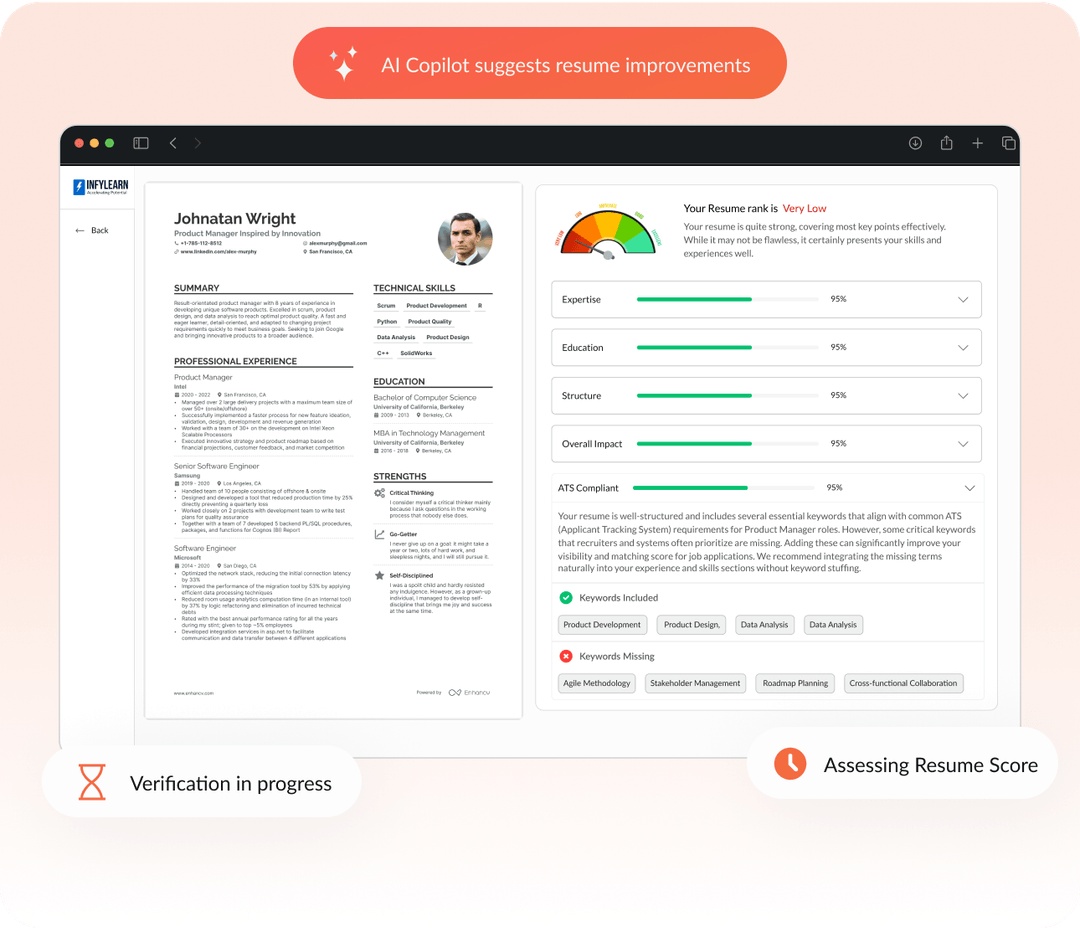
Infy Resume - AI resume copilot, live product

Infy Resume - AI resume copilot, live product

Where the resume gets fixed

Infy Resume

Two one-to-one reviews per student is the right number of human hours. It is not enough iterations, which is what the copilot is for.

  • Built against a real JD - the student pastes the job description and the resume is scored against that, not against a generic template
  • An ATS score they can move - specific, line-level feedback, so a fourth draft is measurably better than the first rather than differently worded
  • Portfolio and GitHub capture - projects, internships and capstones become artefacts a recruiter can open, which is the engineering half of this
  • Unlimited attempts - the human reviews set the standard; the copilot is where a student does the twenty reps between them
Reviewer notes from the two one-to-one rounds land in the same record, so the second review starts where the first one finished.
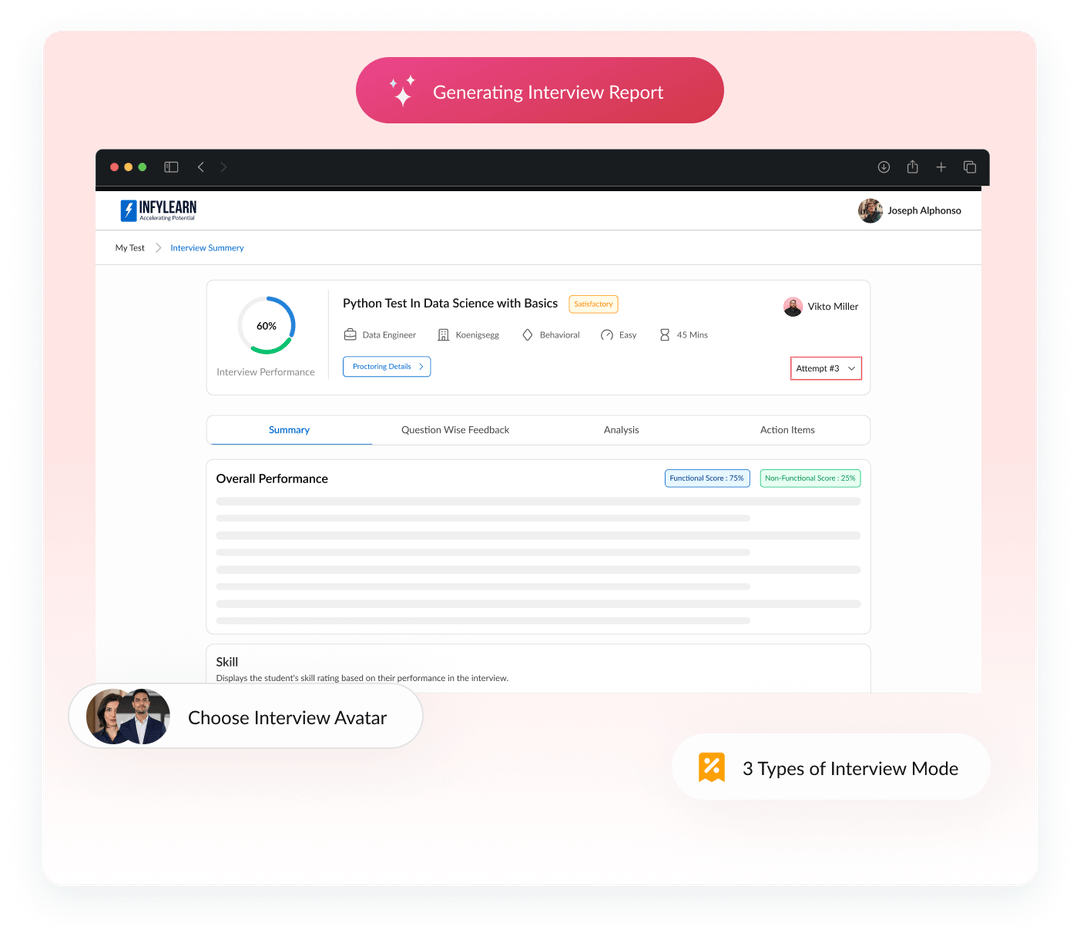
Infy Interview Coach - AI video mock interviews, live product

Infy Interview Coach - AI video mock interviews, live product

Where they hear themselves

Infy Interview Coach

A student gets one offline behavioural mock. They need thirty attempts at the first ninety seconds, and no coach has thirty slots.

  • AI video mock interviews - role- and company-specific question sets, recorded, so the student watches the answer back before anyone else does
  • Filler words, pace and confidence - measured per answer and trended, which turns “be more confident” into something a student can actually work on
  • Written debrief per session - the same debrief your placement cell sees, so coaching in the next one-to-one is not starting from scratch
  • HR, functional and case sets - the question banks match the rounds the programme trains for, not a generic interview
The offline one-to-one mock stays. This is what makes it worth the forty-five minutes it takes.
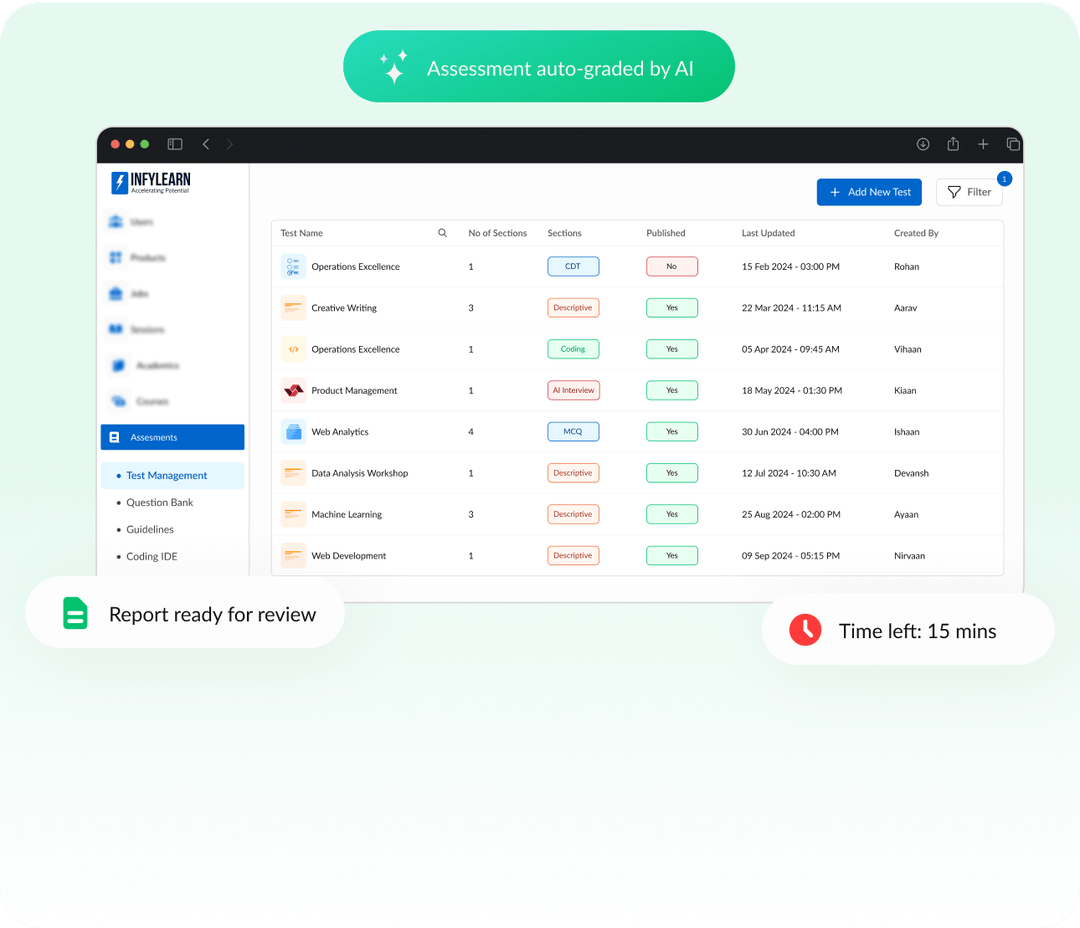
Infy Assess - assessment platform with AI proctoring, live product

Infy Assess - assessment platform with AI proctoring, live product

Where readiness stops being an opinion

Infy Assess

16 tests per student, proctored. A percentile from an unproctored test is a number nobody in a placement meeting should be arguing over.

  • 10 aptitude and 5 domain tests - company-pattern papers, generated per student from a tagged bank, so a leaked paper is worth nothing
  • Psychometric career discovery - one test per student, and the reason the programme can point a student at roles rather than at every drive
  • AI image and video proctoring - flags multiple faces, absence from frame, gaze deviation and tab switching, with every violation logged for review
  • Sectional benchmarking - cohort and per-student percentiles against the cut-offs your recruiters actually set
Pre-assessment before the first session and post-assessment after the last one, which is where the delta in the term report comes from.

Why it matters when you are buying per student

The value of career services is in the reps, and reps are what a spreadsheet cannot hold.

  • Resume drafts, mock recordings, debriefs and test scores sit in one student record, not in four inboxes.
  • A coach walks into the second one-to-one having read the first, which is the only way two sessions beat one twice.
  • Your cell can sort a batch by readiness rather than by CGPA before it decides who goes into which drive.
Included in every engagement

Eight things that are not add-ons

This is the difference between a trainer on a timetable and a programme that moves a batch's numbers. All eight are in the base commercials.

01

Senior faculty, in person

Every class taught on campus by a trainer with 5+ years of teaching experience.

02

Module-wise practice bank

Topic-tagged, so a student weak in Percentages drills Percentages, not a mixed set.

03

E-books & handouts

Produced in-house, so students revise from the same source their trainer taught from.

04

12 months of LMS access

White-labelled to your institution and live for a full year after classes end.

05

Weekly proctored assessments

Under exam conditions on Infy Assess - the reason readiness is a measurement.

06

Monthly challenges & awards

Leaderboards and recognition - the cheapest intervention we know for holding attendance.

07

Remedial classes

Extra sessions for students the data flags as at-risk. Included, not billed separately.

08

Placement-cell reporting

Batch, section and student readiness in one dashboard, plus a termly written report.

Commercials cover offline training, all assessments, learning material and twelve months of platform access. Trainer scheduling assumes a minimum of six hours per trainer per day.

Placement journey personalisation

The batch is trained together. The plan is built one student at a time.

Six steps sit between “we ran a resume workshop” and “we know which forty students are ready for the consulting drive”. None of them is a lecture.

01

Pre-assessment, before a single session

Aptitude, domain and communication tests on the LMS before the programme opens. Not to grade anybody - to find out which of the six pillars this batch is actually weak on, so the hours go there.

Before day one
02

A student profiling report

One report per batch, built from the pre-assessment: where the cohort sits, who is in the bottom quartile, and which students are strong enough to be pushed at the harder drives rather than coached through the easy ones.

Group report
03

A psychometric career discovery test

One test per student, two attempts. It is the difference between a student applying to every company on the calendar and applying to the eight where their profile actually competes.

1 per student
04

JD analysis and a skill-gap map

Real job descriptions from your own recruiter list, broken down into what is being screened for, and mapped against what the student currently has on paper. This is what the resume is then rewritten against.

Per target role
05

Two rounds of one-to-one resume review

Forty-five minutes each, offline, with the AI copilot in between. Round two starts from round one's notes, which is the whole reason there are two.

2 x 45 min, 1:1
06

A recorded mock interview and a written debrief

Behavioural and functional, one to one, forty-five minutes. The student gets the recording and the debrief; your placement cell gets the same debrief, which is how coaching continues after we leave campus.

1:1, recorded
The other placement lever

56 corporate competitions open between July and December. Most batches enter none of them.

A live corporate case competition is the one line on a first-year resume that a recruiter reads before the CGPA - and several of these companies hire the finalists directly. The calendar is public. What is usually missing is somebody making sure teams are formed, briefed and submitted before the deadline.

July8 open
AB InBev - The BUD ChallengeICICI Lombard ILLuminateColgate TranscendRB Global ChallengeTAS invicTASVodafone VantageAmazon AceP&G CEO Challenge
August12 open
HUL LIMENinjakart HustleNestlé 4P ChallengeRBS Case Study ChallengeFlipkart WiREDMahindra War RoomAirtel iCreateAsian Paints CanvasGoogle Case ChallengeBajaj Finserv AtomITC InterrobangTAS TBLA
September7 open
L’Oréal Sustainability ChallengeAccenture B-School ChallengePCBL ChallengersICICI Beat The CurveXiaomi SummitInfosys IngeniousDeloitte Maverick
October16 open
Lodha Soar For MoreMarico Over The WallReNew Power Re-leadHUL FinAceMyntra StylbizCapgemini L’InnovateurEverest National Case StudyEXL AcumenElara CapitalOptum StratethonTVS Credit E.P.I.CTitan ElevateAcuvon Case ChallengeTata Steel Steel-a-ThonAditya Birla Avant-GardeSamsung E.D.G.E
November8 open
RPG BlizzardPiramal TangramHero Campus ChallengeHUL TechTonicGSK E³ Case StudyUdaan Take-OffOYO The CatalystMeero Case Study
December5 open
Reliance T.U.P.Mondelez The New NormalTata Motors MindRoverL’Oréal BrandstormKPMG Ideation Challenge

These are competitions the companies run themselves, not Board Infinity programmes - the calendar is here because it is the thing a placement cell most often misses. Case competition preparation runs on a need basis alongside the main programme: team formation, brief decoding, structuring, deck craft and a mock jury before submission.

Reporting

Every institution gets its own readiness report

A live dashboard through the term and a written report at the end of it - and unusually for this service, a card per student rather than a batch average, because that is the level a placement cell actually makes decisions at.

Board InfinityTerm report · 2026–27
Sample

Placement Readiness Report

MBA · Batch of 2027 · Last Mile Career Services

Students in the programme286
Resumes cleared at review 291%
Mock interview, mean score7.1
Mock GD, mean score6.6
Completed all 16 assessments84%
Students with 3+ role-fit matches72%

What's in the report

  • 01Per-student readiness card - resume state, mock scores, test percentiles and role-fit matches on one row, sortable, for every student in the programme.
  • 02Pillar-level breakdown - where the cohort is strong and weak across branding, screening, interviews and company-specific preparation.
  • 03Pre and post delta - the same assessment before the first session and after the last one, so the term's effect is a number rather than a feeling.
  • 04At-risk register - the bottom-quartile students, what was done about each one, and where they ended up.
  • 05Interview & communication analysis - filler words, pace and confidence trends from Infy Interview Coach, per student and per batch.
  • 06Drive-readiness shortlists - which students are ready for which of your recruiters, and which need one more round before you put them in.
Request a sample report
Delivery

Three ways in, depending on how much term you have left.

Most institutions start with the last-mile programme because it fits a single semester and shows a number by the end of it. The two-year plan is what it grows into.

Most impact

Two-year placement plan

Career services woven through the whole degree: foundation and SIP preparation in year one, functional depth and the last mile in year two.

2years, one
continuous record
01Year 1 · FoundationAptitude, reasoning, verbal, soft skills, executive workshops110 h
02Year 1 · SIP career servicesActivities per student, before the summer internship12
03Year 1 · SIP crash bootcampsEach, across finance, HR, operations, sales and analytics12 h
04Year 2 · Role-based bootcampsFunctional tracks, chosen against your recruiter list5
05Year 2 · Last mile career servicesOffline, Sem 3–4, the programme in the third tab above30 h
06ThroughoutBenchmarked tests per student, plus the competition calendar16

The version that changes a placement number rather than a placement season, because the student's own record follows them from the first semester to the last drive.

Last mile only

One semester, final year, offline on campus. The entry point for most institutions and the one that fits a placement calendar already in motion.

30offline hours
per batch of 60–80
01Resume and brandingWorkshop, 1:1 review, AI copilot, LinkedIn3
02Interview preparationWorkshop, 1:1 functional and behavioural mock, AI mocks3
03Group discussionPreparation workshop and a scored mock GD in groups of 82
04Role and sector clarityOffline, the block that stops students applying blind5 x 90m
05Company-specific sessionsOnline, on demand, against your own recruiter list10 x 60m
06AssessmentsAptitude, domain and psychometric, per student, proctored16

Price includes offline training, assessments, learning material and twelve months of LMS access. Minimum six hours per trainer per day on campus.

SIP to PPO

For institutions whose summer internships are not converting. Workshops before the internship, a mentor at 1:5 through it, and a one-to-one read of the final report.

13sessions across
the internship
01WorkshopsSIP to PPO, conduct, impact, storytelling, reporting, domains6 x 120m
02Buddy mentoring1:5, through the internship - roadmap, doubts, report, deck6 x 60m
03Final report evaluation1:1, before the student presents to the company1 x 45m
04Workshop groupsThe batch splits into four groups for the workshop block4
05DeliveryWorkshops either way; mentoring and evaluation onlineOnline / offline

The narrowest of the three and the easiest to justify: a pre-placement offer costs the placement cell nothing at all in the final-year season.

Session counts and durations on this page are the ones in our current programme tables. Request a proposal for costing against your batch size, the pillars you want covered, and how much of the delivery is offline.


Questions from placement cells

Frequently asked questions

How is this different from a training vendor?

Most of what is on this page cannot be delivered from the front of a room, which is the whole point. Five sessions per student are one-to-one or in a group of five to eight, every one of them is scored and written up, and the debrief goes to your placement cell as well as to the student. What a vendor sells you is a workshop count. What you get here is a per-student record you can sort a batch by.

Are the assessments proctored, and how?

Yes, on Infy Assess. AI image and video proctoring flags multiple faces in frame, a student leaving the frame, gaze deviation and tab switching, with every violation logged for review. Papers are generated per student from a topic- and difficulty-tagged bank, so a leaked question set is worth nothing. That matters more here than anywhere else, because these percentiles get shown to recruiters.

What tracking does our placement cell actually get?

A readiness card per student - resume state, both review rounds, mock interview and GD scores, test percentiles and role-fit matches - plus pillar-level cohort breakdowns, the pre-to-post delta on the same assessment, an at-risk register for the bottom quartile, and drive-readiness shortlists against your own recruiter list. It is a live dashboard through the term and a written report at the end.

What is Board Infinity accredited by?

Accredited and approved by CII as an industry partner for academic credits, an NCVET-approved awarding body, and an approved partner of NSDC and NASSCOM. We are also an ILO partner on labour initiatives and a global Coursera instructor partner alongside organisations like IBM and Google.

How many one-to-one sessions does each student really get?

Five in the extended programme: two resume reviews, a behavioural mock interview, a 1:5 group case-solving session and a 1:8 mock group discussion. The lighter last-mile programme is three - one resume review, one combined functional and behavioural mock, and one mock GD. Everything above that count runs on Infy Resume and Infy Interview Coach, which is where a student can take twenty attempts instead of one.

Can you run this for engineering batches, not just MBA?

Yes. The session tables on this page come from our MBA programmes because that is where the format is most developed, but the pillars are the same for a B.Tech batch - with coding assessments, technical mock interviews and a GitHub and portfolio review in place of the case and guesstimate track. Tell us the branch mix and the recruiter list and the tables come back rewritten.

We already run resume workshops. What are we actually buying?

The part after the workshop. A workshop sets a standard; it does not open 300 documents, check each one against the job description it is going to, and send it back twice. Our honest read is that most placement cells have the workshops covered and are short on one-to-one hours, scored mocks, and a record that says who is ready. If that is not your gap, say so and we will scope the pillars that are.

How late in the year can we start?

The last-mile programme is thirty offline hours and fits inside a single semester, so a start as late as the beginning of Sem 3 still lands before most drives. Below that, the honest answer is that the resume and mock interview blocks are still worth running on their own, and the assessment and role-clarity layers are not - they need a term to be useful.

Who delivers the one-to-one sessions?

Practising senior professionals from the function the student is interviewing for - the same pool that teaches the functional bootcamps - not generalist trainers running a script. For the behavioural rounds and group discussions, coaches who do this full time. Your own placement team is welcome to sit in on any session; several institutions use the first cycle as training for their own staff.

What does it cost?

It depends on batch size, how many of the six pillars you want covered, and how much of the delivery is offline, which is why there is no price on this page. Tell us your batch size and which programme in the third section matches your calendar, and you get costing against that within three working days.

Next step

Let's put a costed plan against your batch

Tell us your batch size, which semester they are in, and the recruiters you are preparing them for. We come back with a session table, a one-to-one allocation and commercials - usually within three working days.

  • A free readiness assessment of a sample batch on Infy Assess, so the pillar mix is chosen from your data rather than from a package.
  • A session table with the one-to-one allocation per student written out, not a workshop count.
  • A sample readiness card for one student, so you can see exactly what your placement cell will be sorting a batch by.

Request a proposal

For placement cells, deans and training coordinators.

Thank you - that's with us

A Board Infinity consultant will come back to you within three working days with a proposed plan and commercials.

Work with Board Infinity

Let’s build something
that drives results.

Write to us
Programmes Request a proposal